

Devlog ·
The knight fights. VESPER forges.
Why Astraya’s AI never fights for you, what the first playtest is for, and what is still rough.
Hi, I’m Saransh. I’m building Astraya on my own, from India, and I’m using it to learn how to build real things with AI, in public, mistakes included. This is the first devlog.
The idea
In most fighting games, your moves are fixed before the fight starts. You learn them, you learn your opponent’s, and the better reader wins. I love that. But I kept wanting one more thing: when you spot a gap in someone’s defence, the chance to answer it with something new.
So in Astraya you have a companion, VESPER. When you see the gap, you tell her: out loud, in your own words, or with a button. A few seconds later she hands you a new move or power, made for that moment. Then you have to land it.
Why the AI never fights
I made one rule early, and I keep coming back to it: the human fights, the AI only forges. VESPER never touches your sword. She can’t block for you, aim for you or choose your timing. If she could, the game would be playing itself, and there would be nothing left for you to get good at.
The second rule: she can only build from the game’s own pieces, the swings, powers and armour that already exist, each with real animation. She proposes; the game’s rules check every move before it reaches your hands, so asking can’t buy you something unfair. A new move gives you an opening. It never guarantees a win.
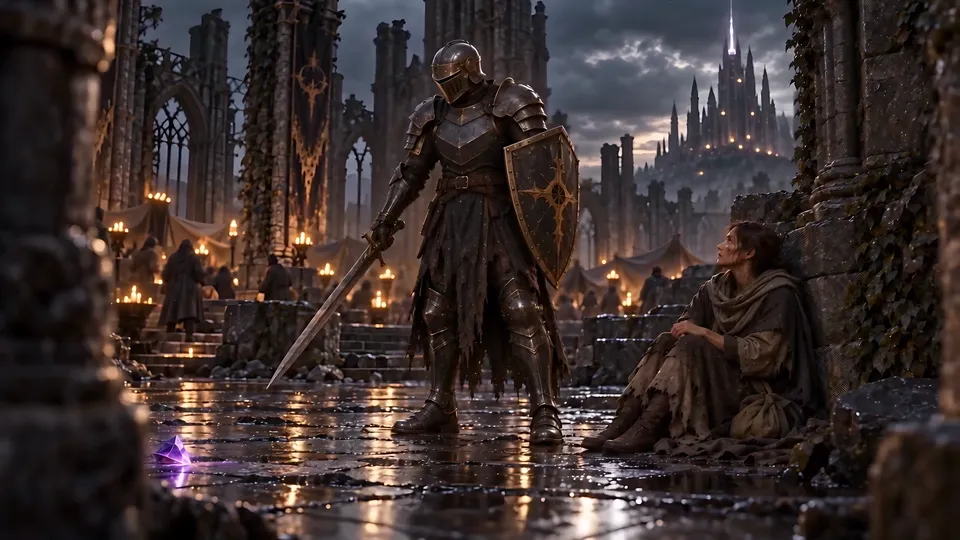
The story grew out of those rules. The bosses, the Shard-Bound, fused their shards into their bodies. It made them far stronger than you, and it silenced the voice inside. They have mastered every move they own, and they can never learn another. You kept your shard’s voice. That is the whole fight: their perfection against your imagination.
What the playtest is for
The first playtest is small on purpose: a handful of people, then a few more. I want to learn four things:
- Does forging feel like magic, or like a gimmick?
- Does VESPER understand you, in English, Hindi and Hinglish?
- Do the Iron Warden and the Crimson Blade feel hard but fair?
- Does it run well on the laptops people actually own?
The plan is for the game to ask a few short questions now and then, two minutes at most. Every forge costs real money to run, and I read every report myself, so small batches keep both honest.
Honest about AI
Astraya uses AI in two ways, and I’d rather you hear it from me.
- Live, while you play. When you speak, a speech service turns your voice into text. An AI model then builds VESPER’s answer from the game’s own fixed set of pieces, and writes its name, the short text on its card and the line she says. A voice service speaks that line in a voice designed for her. The game’s rules check every move before you can use it.
- Made beforehand. The trailer, the skies, the character voices, the narrator and the trailer’s music were made with AI tools, which I directed, chose from and edited. So were the 3D models of the knight, the bosses and some arena props, which I then rigged and fixed by hand. Some of the story paintings were made with AI too; for the rest I have no record yet, so treat them as possibly made with AI. I don’t have an art team; this is how one person gets a world on screen.
The fighters' movement is motion capture and hand-built animation, not AI. The menu music was composed in code. The trailer is a story cinematic, not gameplay. The full list is in the Playtest Agreement.
What’s still rough
- The third Shard-Bound, Ember-Forged, is still being forged. The playtest has two: the Iron Warden and the Crimson Blade.
- The bosses haven’t had their full balance pass yet.
- VESPER sometimes mishears you, or writes a Hindi word in the wrong script.
- On some laptops, the higher graphics settings can lag.
- It plays on a PC or laptop, with a keyboard or a controller. Phones can read this site, but they can’t play.
- A short tutorial, a Training mode and a way to change your keys are being finished right now.
- Online Versus is planned for later, for pairs I invite.
If those sound like problems you’d enjoy finding, join the list. And if you read this far: thank you. I’ll keep writing these as I go.
— Saransh